


Heeled Mules That Stay On the Foot: A Sourcing Guide for Buyers
Sep 28, 2026
Leave a message

After years of shipping heeled mules, I will say it plainly: the style is not the problem, the fit is. A mule has no back to hold the foot, so retention comes down to the vamp, footbed and sole balance. Get them right and mules sell; miss them and they come back.
That is why mules are the most demanding heel silhouette to source. A pump can hide a mediocre fit behind a heel counter; a mule can hide nothing. Retention has to be engineered into the last, the footbed and the balance of the finished shoe - all decided at specification and sample stage, never afterwards on the shop floor.
1. Why the Mule Is the Hardest Heel to Fit
A mule is defined by what it lacks: no heel counter, no back strap, nothing wrapping behind the ankle. The foot is held by the front of the shoe alone, and fitting guides describe the result accurately - the foot slides forward until the vamp hugs the instep, and the heel stays open and unconstrained.
That single missing part changes the engineering of the whole shoe. A pump takes up slack with a heel counter and a back seam. A mule's only clamp is the vamp line across the instep, and its only cradle is the footbed underneath. If either is wrong, nothing later in production corrects it - you cannot tighten a mule the way you tighten a lace-up.
Commercially, the silhouette is worth getting right. Industry reporting has placed mules, clogs and flats among the seasonless women's categories still growing while seasonal styles slowed (Yahoo Finance, July 2024). Buyers keep adding mules to the line, and the same fit failures keep repeating.
2. The Four Forces That Push a Mule Off the Foot
Understanding the mechanics is what separates a productive sample review from an opinion swap. Four forces act at once.
1. Gradient slide. A heel raises the footbed at the back, so the foot constantly wants to travel toward the toe. The higher the heel and the steeper the gradient, the stronger the force.
2. Toe clawing. Because the shoe cannot be pulled back, the wearer's toes curl to grip the footbed - and fitting guidance notes that loose backless shoes encourage exactly this compensation. It is why a customer can call a mule a fit and still find it exhausting: the shoe is held on by muscular effort, not by construction.
3. Footbed volume mismatch. If the volume around the foot is wrong, no accessory closes the gap. Fitting advice on backless styles is explicit: when a shoe slips because there is excess volume, a heel grip alone will not fix it - the volume must be filled or the last changed. Volume, not length, decides whether a mule sits still.
4. No heel stabilisation. With no counter and a low collar, an open-heel shoe shifts more during walking than a closed-back design. The wearer feels that movement even when the shoe stays on, and repeated movement becomes a complaint.
3. Five Things to Lock in the Mule Specification
The specification is where mule fit is won or lost. These five items cover the retention mechanism completely, and each is measurable before tooling is cut.
| Spec item | What to specify | What goes wrong if it is left open |
| Last and instep volume | Instep girth at the vamp line, stated per size | Vamp too loose and the foot slides; too tight and the instep takes pressure |
| Vamp geometry | Band width, position on the foot, single band or cross band | A thin band on a heavy heel has too little contact area to hold the foot |
| Footbed contour | Arch height, heel-seat cupping depth, forefoot cushioning | A flat footbed gives the foot nothing to settle into and it travels forward |
| Sole rigidity and balance | Shank stiffness, where the sole flexes, heel-to-forefoot balance | A sole that flexes in the waist pushes the foot forward; a heavy heel drags the shoe back |
| Heel body weight and lining friction | Heel material weight at the specified height; footbed lining material | A heavy heel plus a slick lining is the fastest route to a slipping mule |
Two of these are routinely missing from buyer specifications. Heel body weight is almost never stated, though it decides how the finished shoe hangs on the foot. Footbed lining friction is treated as cosmetic, yet a suede-split lining and a slick coated one behave completely differently under a damp foot.

Three of the specification items made visible on the bench: the last that sets instep volume, the girth under tape, and a footbed with a raised arch and a cupped heel seat.
4. Vamp, Footbed and Lining: Where Retention Actually Comes From
Retention is designed, not tightened. Three components do the work.
The vamp line is a clamp. Its contact area and tension decide how much of the foot is held. A wide cross band spreads pressure over a larger area and tolerates variation between feet. A single thin band concentrates pressure on one line, so retention depends on tightness alone - which is why customers describe thin-band mules as either cutting in or falling off, rarely anything between.
Adjustability widens the fit window. A buckle, a hidden elastic insert or a strap crossing further back lets one size serve a wider range of insteps. It costs a little more in assembly and reduces fit returns, which is usually the better trade.
The footbed is not a flat board. A shallow cradle - raised arch, cupped heel seat, cushioned forefoot - resists forward travel, because the foot must climb out of a depression before it can slide. Footbeds marketed for backless styles combine exactly these features. A flat footbed with a sleek lining is a smooth ramp toward the toe.
So when a mule slips, do not reach for the strap. Ask what the footbed contour and the vamp contact area are, because those decide.
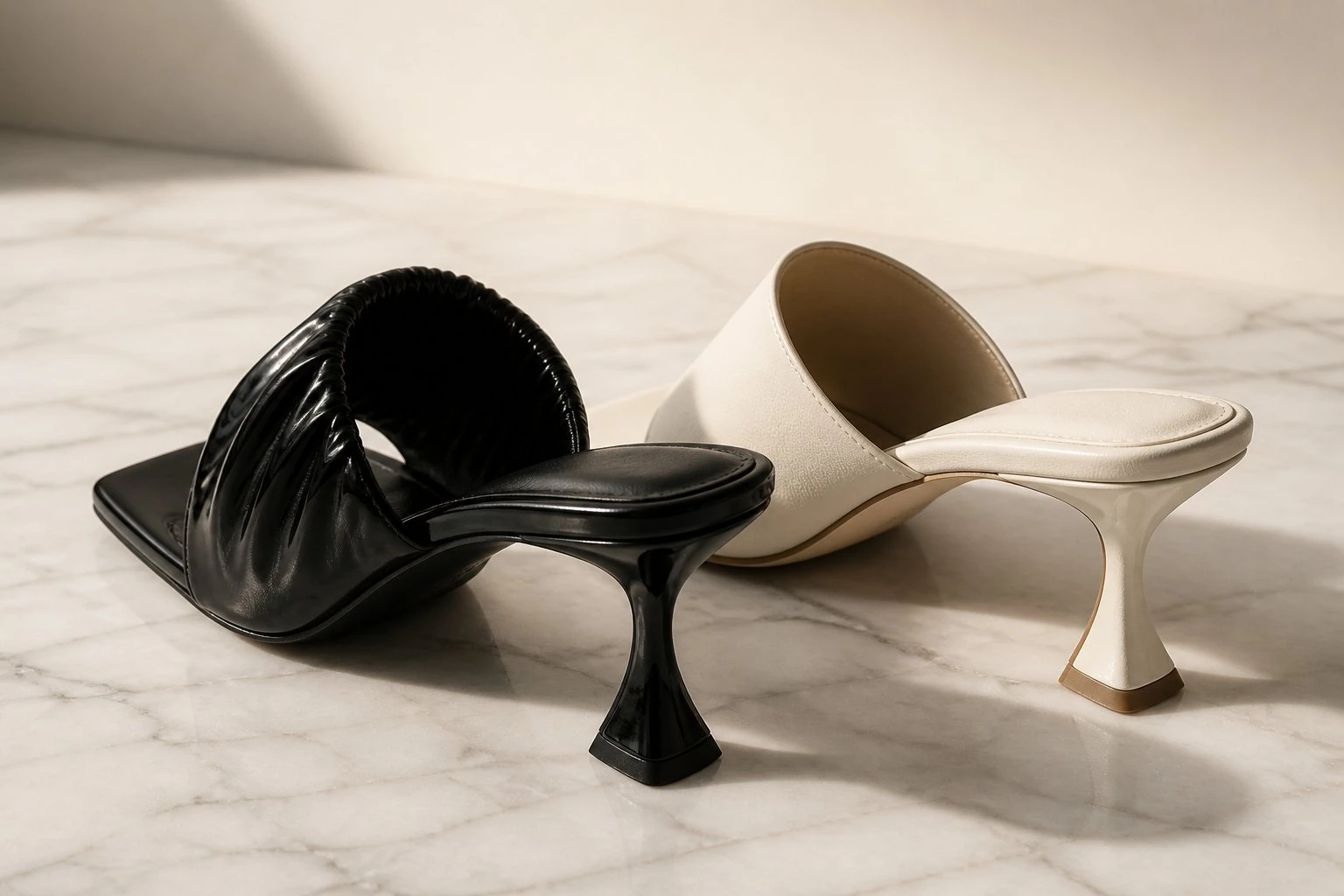
Where retention actually comes from: the band clamping the instep, and a footbed the foot has to climb out of before it can slide toward the toe.
5. Sizing and Grading: Why Mule Size Is Not Pump Size
A mule can be the right length and still the wrong shoe. Because retention comes from the instep and the vamp rather than the heel, the deciding dimension is volume, not the number on the box. Retail fitting guidance for mules advises matching width to the shape of the foot - narrower for slim feet, wider for broader feet, so the band does not have to be forced into position (ShoeZone mule fitting guide).
Two consequences follow for anyone buying mules.
Grade volume, not only length. A run in which only length is graded produces loose upper sizes and tight lower ones, and the customer notices on the largest sizes first. Instep girth belongs in the graded specification alongside length and width.
Test the extremes. The middle size usually fits; ask for the smallest and largest in the trial, where volume errors become visible. Resist the folklore that mules must always be bought a size down or a size up - the answer depends on the last, and the only reliable way to know is to test the two sizes either side of the customer's usual one and record what the panel says.
6. A Retention Test You Can Run Before Bulk
You do not need a laboratory to make mule fit a measured property instead of a matter of opinion. This protocol fits inside a normal sample round and produces evidence you can hold a factory to.
1. Test the extremes. Sample the smallest and largest sizes in the run, not only the middle.
2. Use a mixed panel. Eight to ten testers per size, deliberately including different instep heights and foot widths.
3. Run the walk-off test. Have each tester walk a defined distance on hard tile, then carpet, then descend a flight of stairs. Record the number of steps before the heel visibly lifts, and which surface caused it. Static fit checks miss this entirely; the problem appears in motion.
4. Measure the volume back at the factory. Measure instep girth on the finished sample and compare it with the specification. If the measured girth drifts, the last or the upper pattern is moving.
5. Check static balance. Place the pair on a flat surface. An unbalanced mule rocks; a heavy heel body will drag the shoe backwards off the foot. Balance is a construction property, and it is visible in ten seconds.
6. Run a two-week wear trial with a written complaint form covering slip, cramping, blisters and the tiredness of holding a shoe on with the toes. Ask for counts, not impressions.
7. Keep a signed reference pair. Retain the approved pair and the recorded measurements - the only things that settle a fit dispute after bulk.
7. Which Mule Constructions Are Easier to Get Right
Retention difficulty is mostly a function of how much work the vamp and the footbed have to do on their own.
| Construction | Retention difficulty | Why |
| Low block heel with a wide cross band and a contoured footbed | Lowest | Short gradient, large contact area, and a footbed that resists forward travel |
| Wedge or covered-heel mule with a contoured footbed | Low | Continuous contact under the arch gives the foot a longer surface to settle on |
| Mid-height sculpted or spool heel with a cross band | Moderate | Steeper gradient, so the footbed contour has to carry more of the load |
| Tall spool or stiletto heel with a single thin band | Highest | Steepest gradient, smallest contact area, and the least tolerance for a flat footbed |
| Any of the above on a flat footbed | Risk multiplier | Removes the only mechanism that resists forward slide |
None of this is about price point. A well-built tall heel can hold the foot if the footbed is contoured and the band broad enough, and an inexpensive low heel can slip if the footbed is flat and the vamp thin. The variable is where you spend the construction budget, not how much of it there is.
Most mule programmes contain a mix of these constructions - a wide cross band on a mid block heel, a wedge with a contoured footbed, a sculpted heel carrying a lighter band. That mix is worth reviewing as a set, because it shows which constructions your line depends on and where the fit risk is concentrated.

Three retention profiles in one row: a wide cross band on a low block heel, a continuous wedge with a crossover band, and a lighter band carrying a tall spool heel - the last being the construction with the least tolerance for a flat footbed.
8. Questions to Ask a Mule Supplier
- Do you develop a last for backless styles, or will this be built on a pump last? This is the first question, because a pump last leaves the instep volume unresolved.
- What instep girth are you targeting, and is it graded across the size run? If the girth is not stated per size, volume is left to chance.
- What is the heel-seat cupping depth and the arch height on the footbed? These two numbers are the difference between a cradle and a slide.
- How wide is the vamp band, and is it adjustable? Band width and adjustability together define the fit window.
- Which lining goes on the footbed? Ask how it behaves with a damp foot, not only how it looks in the sample.
- What does the heel body weigh at this height? Weight decides how the finished shoe hangs and how it drags in wear.
- Will you test the smallest and largest sizes before bulk, and keep the reference pair? A reasonable request on any mule programme.
- What is the MOQ per style and per colour if I want to test two vamp widths? A second vamp width is often cheaper than a season of fit complaints; see our low MOQ programme for how trial orders are structured.
9. FAQ: Sourcing Heeled Mules
Why do mules slip off even when they seem to fit?
Because retention is a construction property, not a size property. Length can be correct while the instep volume, the vamp contact area or the footbed contour is wrong, and no strap adjustment compensates for a footbed with nothing to hold the foot.
Should mules be sized up or sized down?
Neither rule is reliable. The deciding dimension is volume rather than length, and fitting guidance matches width to foot shape - narrower for slim feet, wider for broader feet. Test the two sizes either side of the customer's usual one and let the panel decide.
Can a heeled mule be made to work for wider feet?
Yes, but it is a tooling decision rather than a strap decision. A last developed for the width plus a broader vamp band will hold a wider foot; reusing a narrow last usually produces pressure instead of retention. Expect the width to be quoted as a separate development item.
Which heel height is easiest to keep on the foot?
A lower block heel with a contoured footbed and a broad vamp band. As height rises the footbed contour has to carry more of the retention load, so taller and slimmer constructions depend far more on how the footbed is shaped and how light the heel body is.
Start Your Mule Programme
Send us your mule design, a reference sample or a technical file, and we will review the vamp geometry, instep volume and footbed contour with you before tooling is cut.
Mychonly, the export brand of Huangxuan Footwear Co., Ltd., supplies brands and importers in more than 30 countries, with low MOQ starting from 200 pairs - what makes a two-width trial realistic.
Request a quote or sample, contact our team, or browse current women's mules and sandals.
If your range also includes pointed styles, our guide to sourcing pointed-toe women's heels without compromising comfort covers the toe-box side of the same fit decision.