


Sourcing Men's Casual Sneakers: Key Functional Indicators
Jan 05, 2026
Leave a message

What key functional indicators should I focus on when sourcing men's casual sneakers from China?

You found a supplier with unbeatable prices, but you are terrified the shoes will fall apart after a month. If your sneakers crack or slip, your brand's reputation will vanish overnight.
To ensure quality, you must focus on Flexing Resistance (40,000 cycles without cracking), Sole Bond Peel Strength (≥ 3.0 N/mm), and Slip Resistance Coefficients (> 0.30 CoF). These functional indicators scientifically prove your sneakers can withstand daily wear and tear.
Let's move beyond the surface aesthetics and dive into the lab tests that separate professional manufacturers from cheap workshops.
How do I verify that the rubber outsoles meet the necessary slip resistance standards?
Slippery shoes are a liability lawsuit waiting to happen. You cannot afford to sell a sneaker that turns a wet sidewalk into an ice rink for your customers.
You must verify slip resistance by requiring the ISO 13287 or GB/T 3903.6 standard test. Ensure your casual sneakers achieve a Dynamic Coefficient of Friction (CoF) of at least 0.30 on wet ceramic surfaces and 0.28 on the heel to guarantee safety.

When I talk to buyers like Jeff Smith, they often ignore slip resistance [1] because they think, "It's a casual sneaker, not a work boot." But in my experience at Mychonly, urban environments are dangerous. Polished concrete, wet tiles, and oily asphalt are everywhere. If your shoe slips, the customer blames the brand, not the floor.
Understanding the Coefficient of Friction (CoF)
The CoF is a number that tells you how "grippy" a shoe is. It is not an opinion; it is physics.
- Static Friction: The force to start moving.
- Dynamic Friction: The force to keep moving (sliding).
For sneakers, we care about Dynamic Friction [2]. If a customer is walking and hits a wet patch, we want the shoe to stop the slide, not accelerate it.
The Testing Protocol
We use a machine that presses the shoe onto a surface (like a ceramic tile) with a specific weight and then pushes it forward. We add water or glycerol (oil) to simulate real-world messes.
- The Standard: For a general purpose "casual" sneaker, a CoF of **0.30** is the industry safe zone. Anything below 0.25 is dangerous.
- The Tread Pattern: It is not just about the rubber compound; it is about the geometry. Flat soles slip. You need channels to disperse the water, similar to a car tire.
Specialized Testing for Urban Environments
If you are selling to a market that experiences a lot of rain (like London or Seattle), I recommend adding the "Oil-Wet" test. Standard rubber might grip water but fail miserably on oil. We can adjust the rubber formula by adding specific polymers that cut through oil, but this increases the cost. You need to decide if that performance is worth the price for your specific customer.
Slip Resistance Standards Table
| Test Condition | Minimum Safe CoF (Casual) | High-Performance CoF | Risk Level if Failed |
|---|---|---|---|
| Dry Ceramic | > 0.40 | > 0.50 | Low (Most shoes pass) |
| Wet Ceramic | > 0.30 | > 0.40 | High (Common slip hazard) |
| Wet Steel | > 0.25 | > 0.35 | Medium (Industrial vibe) |
| Glycerol (Oil) | > 0.15 | > 0.25 | High (Kitchen/Street hazard) |
What are the standard abrasion resistance requirements for durable casual sneaker soles?
Customers hate when their soles go bald after just a few weeks of walking. A worn-out sole makes your premium brand look cheap and disposable.
Standard abrasion resistance is measured by volume loss using the DIN method (ISO 4649). High-quality casual sneakers should have a volume loss of less than 150mm³, while cheaper "market quality" soles often exceed 250mm³, leading to rapid wear.

I have seen beautiful sneakers that look perfect in the box but turn into trash after walking 50 miles. This happens because the factory used "filler" in the rubber. To save money, they mix more clay and calcium carbonate into the rubber formula. It looks the same, but it wears away like an eraser.
The DIN Abrasion Test
We use the "Rotating Drum" method (DIN 53516 / ISO 4649 [3]).
- We weigh a sample of the rubber.
- We press it against a rotating drum covered in standardized sandpaper for a specific distance (usually 40 meters).
- We weigh it again to see how much rubber disappeared.
- We calculate the **Volume Loss** in cubic millimeters (mm³).
Note: In this test, a **LOWER** number is better. You want to lose *less* rubber.
Setting Your Quality Standard
- The Trap: If you just say "rubber outsole" on your PO, a bad factory will give you a DIN of 300mm³. This is soft and cheap.
- The Fix: Specify "DIN abrasion < 150mm³" for high-quality casual use. If you are making a skater shoe that needs to endure grip tape, you might need DIN < 100mm³, but that requires a much more expensive rubber formula.
The Anti-Yellowing Factor
While we are talking about sole longevity, we must mention appearance. White soles are popular, but they turn yellow due to UV oxidation [4]. This is a chemical failure.
- The Test: UV exposure lamp for 12-24 hours.
- The Grade: We use a Gray Scale from 1 (worst) to 5 (best). You must demand **Grade 4** or higher. If you don't, your inventory might turn yellow while sitting in your warehouse before you even sell it.
Rubber Quality vs. Volume Loss Guide
| Quality Level | DIN Volume Loss (mm³) | Durability Expectation | Material Composition |
|---|---|---|---|
| Premium / Skate | < 100 mm³ | Excellent (12+ months) | High rubber content, minimal filler |
| High-End Casual | < 150 mm³ | Good (6-12 months) | Balanced formula |
| Market Standard | < 200 mm³ | Average (3-6 months) | More clay filler used |
| Cheap / Budget | > 250 mm³ | Poor (< 3 months) |
Mostly filler, little rubber
|
How can I ensure my customized sneakers pass the flexing resistance test to prevent cracking?
A cracked sole is a catastrophic failure that destroys customer trust instantly. You need to verify that your shoes can handle the thousands of steps your customers take every day.
You must mandate the GB/T 3903.1 or ISO 24266 flexing test, requiring the shoe to withstand 40,000 cycles at a 45-degree angle. A passing grade requires no visible cracking in the sole and no delamination (separation) between the upper and outsole greater than 5mm.
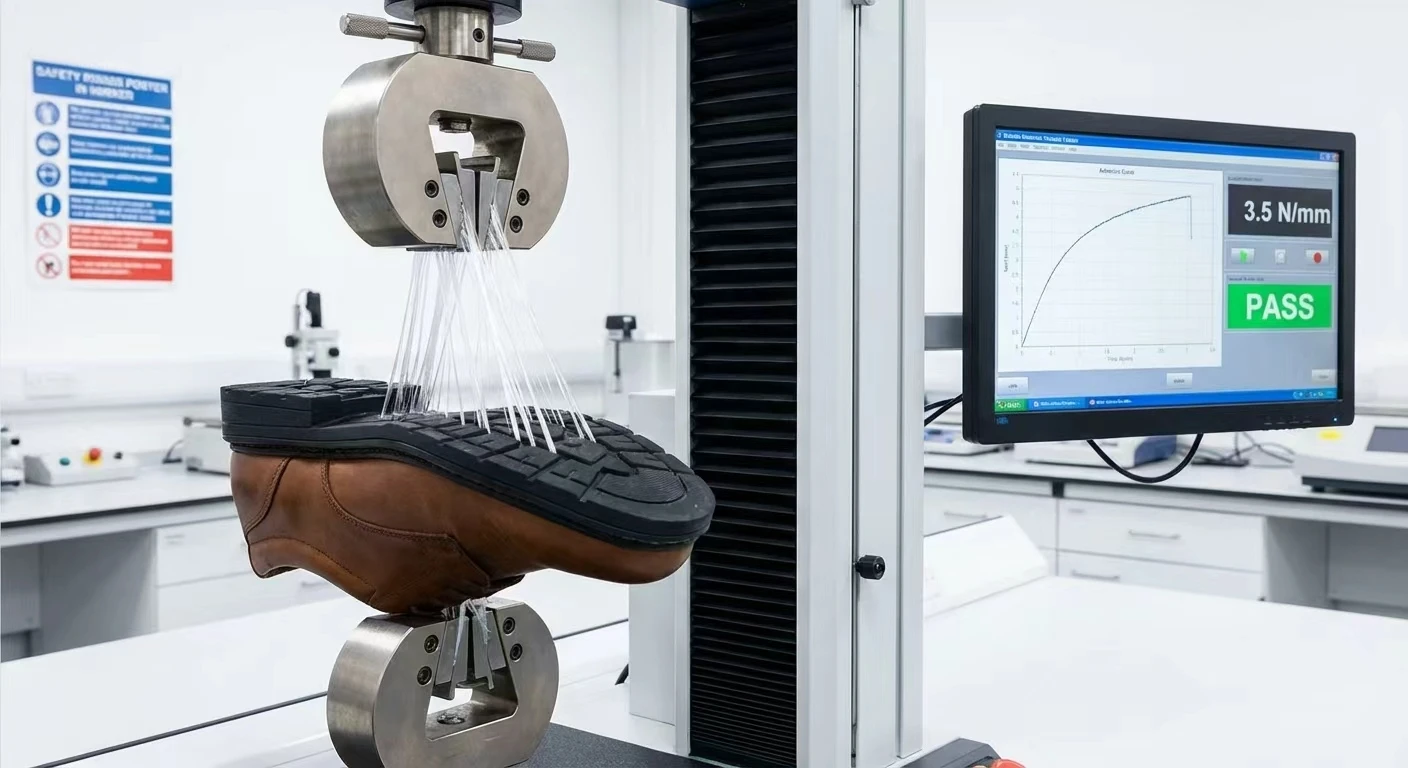
Flexing [5] is the ultimate stress test for a sneaker. It tests not just the rubber, but the glue, the stitching, and the material fatigue. At Mychonly, we call this the "torture chamber." If a shoe survives this, it will survive your customer.
The Flexing Test Protocol
We clamp the forefoot of the finished shoe into a machine that bends it repeatedly.
- Angle: Usually 45 degrees, simulating the toe-off phase of walking.
- Speed: about 230 cycles per minute.
- Duration: 40,000 to 50,000 cycles. This simulates roughly 3-6 months of heavy walking.
After the test, we inspect the "flex area" with a magnifying glass. We look for tiny cracks in the outsole or the sidewall. If the cut grows more than 4mm, it fails.
Sole Bond Peel Strength
Flexing also tests the glue. If the glue is weak, the upper will peel away from the sole.
- The Metric: You need a Peel Strength [6] of **≥ 3.0 N/mm** (Newtons per millimeter).
- The QC Trick: In mass production, we cannot destroy every shoe. So, use the "Rapid Sole Adhesion Test" (SATRA TM404 [7]) at the toe and heel on the production line. This pulls the sole with a specific force to ensure it doesn't pop open, without destroying the shoe.
The "Lasting Margin" Secret
Here is an insider tip that most buyers miss. The "Lasting Margin" is the amount of upper material that wraps *under* the insole to be glued to the sole.
- The Risk: To save fabric, factories trim this margin to 8-10mm. This is too short. There isn't enough surface area for the glue to grab.
- The Requirement: Demand a lasting margin of **15-20mm**. You can't see this on a finished shoe, so you must inspect it during the assembly process or cut open a sample.
Hydrolysis: The Silent Killer
If you use PU (Polyurethane) midsoles, flexing isn't enough. You need the "Jungle Test [8]." PU can rot from the inside due to humidity.
- The Test: 70°C at 95% humidity for 7 days.
- The Result: If the sole crumbles or cracks after this, it will disintegrate during ocean freight.
Flexing Failure Indicators
| Defect Type | Cause | Solution |
|---|---|---|
| Sole Cracking | Rubber too hard / Bad curing | Adjust curing time or formula softeners |
| Delamination | Weak glue / Oily surface | Check primer usage and roughing process |
| Upper Tearing | Material fatigue | Reinforce flex point with backing |
| Paint Peeling | Incompatible paint | Improve paint adhesion or switch ink type |
Should I specify shock absorption metrics for the insoles to guarantee daily walking comfort?
Stiff shoes lead to tired feet and bad reviews. Comfort is the number one reason customers choose casual sneakers, yet many brands leave this to chance.
Yes, you must specify shock absorption metrics. Use the Asker C hardness scale to ensure consistent midsole density (tolerance ±2 degrees) and check torsional stability to prevent arch fatigue. This guarantees that every pair offers the same "step-in" comfort.

"Comfort" is subjective, but "Hardness" is objective. I can measure hardness. When I develop a shoe for a client, we don't just ask, "Does it feel soft?" We ask, "Is it Asker C 55?"
Asker C Hardness Consistency
The midsole (usually EVA) is the engine of comfort. If the foam is too soft, it collapses (bottoms out). If it is too hard, it feels like a brick.
- The Sweet Spot: For men's casual sneakers, **50-55 Asker C [9]** is usually ideal.
- The Tolerance: You must set a tolerance of **±2 degrees**. If the left shoe is 50 and the right shoe is 58, the customer will walk unevenly. This causes back pain and returns.
- The Test: The inspector pokes the midsole with a durometer needle in three spots: heel, arch, and forefoot.
Torsional Stability (The Shank Check)
Many factories cut costs by removing the "shank"-a stiff strip in the arch area. Without it, the shoe twists like a wet rag.
- The Functional Check: Hold the heel and the toe. Twist them in opposite directions.
- Good Result: There should be resistance in the midfoot.
- Bad Result: The shoe twists easily into a spiral. This leads to arch fatigue because the foot has to work harder to stabilize itself.
Chemical Safety Mandates (GB 25038-2024)
Comfort is also about safety. The new Chinese national standard (GB 25038-2024 [10]) strictly regulates chemicals. You must test for:
- Phthalates: ≤ 0.1% (Softening agents in plastics).
- Formaldehyde: Common in glues and fabric finishing.
- PAHs: Found in cheap rubber processing oils.
If your insole is soft but full of toxins, it can cause skin irritation. Ensure your comfort materials are also chemically compliant.
Comfort Metrics Checklist
| Component | Metric to Specify | Target Value | Effect on User |
|---|---|---|---|
| Midsole Hardness | Asker C | 52 ± 2 degrees | Cushioning vs. Stability balance |
| Rebound Rate | Vertical Rebound % | > 45% | "Bouncy" energy return feel |
| Torsional Rigidity | Twist Resistance | Moderate/High | Prevents arch fatigue |
| Insole Thickness | Millimeters | > 5mm (Heel) | Step-in plushness |
Conclusion
Quality is measurable. by specifying CoF for safety, DIN for abrasion, and Flex cycles for durability, you transform "hope" into data. At Mychonly, we use these metrics to guarantee your sneakers survive the street and build your brand.