


How long does custom shoe sampling production take?
Aug 19, 2026
Leave a message

Strategic Lead Time Management and Project Planning in Footwear Procurement
I. Sample Development Lead Time: Resolving the Perception Gap

The Lead Time Estimation Paradox
Talk to any footwear buyer, and the first friction point you'll likely hit is the "7-day vs. 14-day" gap in sample lead times. While brands expect a one-week turnaround, the reality on our factory floor involves a much more complex sequence. Misunderstandings often arise from conflicting estimates: where one party (often the buyer) may estimate a development window of 7 days, another (the factory) often states it takes a minimum of two weeks.
This gap usually stems from a failure to account for "invisible" stages of development. A 7-day estimate often refers to the physical assembly of a shoe that already has materials in stock. However, a realistic two-week timeline accounts for the "relevant party" being informed of the actual lead time provided by the factory, which includes administrative processing, line scheduling, and technical preparation. Experience shows that when clients are surprised by factory feedback, it is typically because the complexities of "multiple processes such as logo production and material color selection" were not fully factored into the initial plan.
1.2 The Anatomy of Sample Development
Sample development optimization requires a granular understanding of its components. A prototype is not merely a "test shoe"; it is a complex assembly of:
- Logo Production: Creating high-frequency molds, silk screens, or metal hardware (requires 3-5 days).
- Material Color Selection: Sourcing specific leather, mesh, or synthetics and performing lab-dip comparisons to ensure Pantone accuracy.
- Adjustment Lead Time: It is a fundamental rule that extra time will be required if clients propose adjustments after sample completion. A single change in a decorative stitch or a foam density can reset the assembly clock.
II. Development Optimization: Existing Mode vs. Custom Tooling
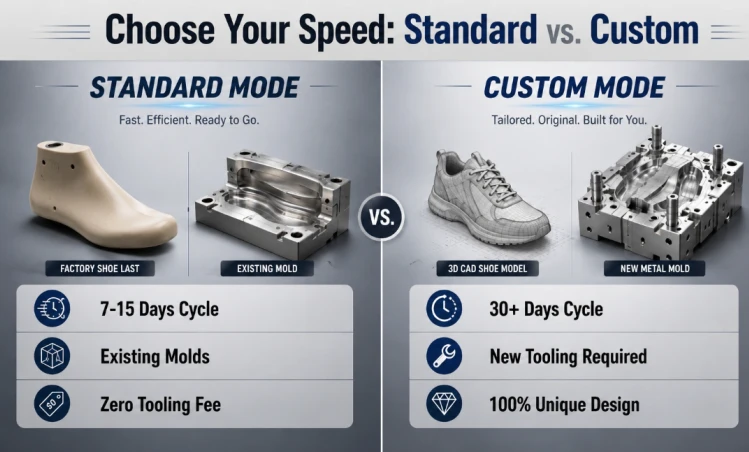
2.1 The Existing Mode Advantage
For brands looking to optimize speed and budget, adopting the existing mode for sample development is a significant advantage. Using a factory's current outsole molds and shoe lasts is not only easier but can drastically reduce costs by eliminating tooling fees.
Standard Sample Production Cycle: When using existing molds, the standard cycle usually takes between 7 to 15 days. This is the "sweet spot" for fast-fashion and seasonal updates where the structural foundation of the shoe remains unchanged.
2.2 The Custom Development Timeline
Conversely, projects involving client-owned outsole designs represent a different tier of complexity. The Custom Development Timeline for developing a new mode (outsole mold) and a corresponding shoe last for a client's own outsole design takes a minimum of 1 month. This month is non-negotiable, as it involves 3D CAD modeling, wooden last carving, and the casting and finishing of steel or aluminum molds. Any attempt to compress this window usually leads to structural defects in the final product.
III. Bulk Order Lead Time and Extension Scenarios

Once the "perfect" sample is signed off, the logic changes completely for mass production. It's no longer about a single pair; it's a 30-day logistical puzzle that begins the moment your material deposit is confirmed.
3.1 The Sequential Production Process
After the client places a bulk order, the lead time is governed by a series of interconnected phases:
- Material Procurement: Sourcing the bulk quantities of uppers, linings, and reinforcements (often 20-30 days).
- Die Cutting: Precision cutting of the materials using hydraulic presses and molds.
- Sewing/Stitching: The labor-intensive assembly of the upper components.
- Quality Checking (QC): A rigorous review of bonding strength, stitching alignment, and cosmetic perfection.
- Shape Cooling: Ensuring the shoe sets properly on the last to maintain its form.
3.2 Navigating Lead Time Extension Scenarios
Professional procurement plans must account for scenarios where the lead time will be extended. The most common "delay triggers" include:
Repeated Client Changes: Ongoing design or material changes after the production file is locked.
Factory Peak Season Shortages: During high-demand periods, material shortages at the sub-supplier level can paralyze the stitching line.
Export Certification Tasks: Compliance testing (such as REACH, ASTM, or specific brand-required lab tests) adds a mandatory layer of time that must be cleared before the goods can ship.
IV. Overseas Footwear Brand Procurement Execution Flow
For overseas brands, geography and time zones add a layer of risk. A structured execution flow is the only safeguard against project slippage.
4.1 Project Breakdown and Confirmation
A successful project is built on clear communication and realistic scheduling.
Set clear deadlines for each step: Break down the project into individual item confirmations.
Reserve a buffer: Always include extra time for unexpected delays such as design changes, peak season shortages, or export certification hurdles.
4.2 Sample Review and Time Planning
Review Cycle: Send samples to the client for review and collect modification feedback promptly.
Sample Adjustment: Ensure all final confirmations are recorded in writing before moving to bulk production.
Time Alignment Requirements: Align timelines of both parties. Confirm factory schedules and holiday shutdown times with suppliers; overseas buyers should work backwards from brand launch and marketing schedules to confirm the latest possible order and shipment times.
4.3 Milestone Management and Change Reduction
Milestone Management Method: Set key milestones and use a table to record planned and actual completion times for progress tracking.
Change Reduction Measure: Write down all requirements, including designs, textures, and sizes in advance. Add reference pictures to avoid verbal-only misunderstandings and to reduce the time spent on changes.
Sample Development and Change Management Rules: Confirm all specifications before starting sample development; agree in advance on the revision count and additional revision costs to avoid unlimited repeated adjustments.
V. Supplier Communication and Record-Keeping Requirements
5.1 Feedback Specification Requirement
Feedback to suppliers shall be precise and specific. Vague instructions like "make it look better" cause delays. Instead, comparison pictures should be attached to help suppliers quickly identify problems and implement fixes in a single iteration.
5.2 Written Record Requirement
VI. Custom Shoe Project Planning Guidelines
6.1 Realistic Planning vs. Shortcuts
6.2 The Risk Reminder
6.3 Proactive Supplier Communication
Final Thought